Your Landing Page Is Bleeding Money
Here's something most SaaS founders don't realize: 53% of mobile visitors leave a page that takes longer than 3 seconds to load. Not 10 seconds. Not 30. Three.
If your SaaS landing page takes 5 seconds to load — which is average for most sites built on Webflow, WordPress, or poorly optimized React — you're losing over half your traffic before they even see your product.
Let that sink in. You're paying for ads, writing content, building features — and more than half the people who click through never see any of it.
What "Slow" Actually Means
When we talk about page speed, we're not talking about how fast it feels to you on your office Wi-Fi. We're talking about how Google measures it — and how your users experience it on a 4G phone on the subway.
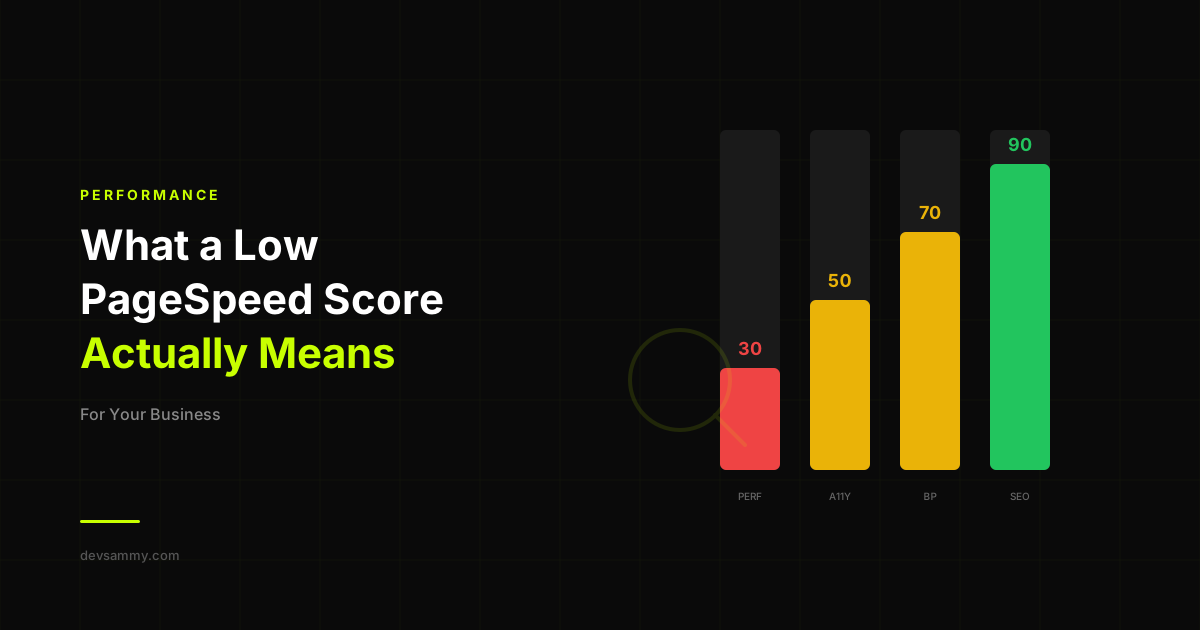
Google uses a tool called Lighthouse that scores your site from 0 to 100 across four categories:
- Performance — How fast your page loads and becomes interactive
- Accessibility — Whether everyone can use your site, including people with disabilities
- Best Practices — Security, modern standards, and code quality
- SEO — Whether search engines can find and understand your content
Most SaaS landing pages score between 30 and 60 on performance. That's not just "room for improvement" — that's actively hurting your business.
The Real Cost of a Slow Landing Page
This isn't about vanity metrics. Speed directly affects the numbers that matter:
1. Conversion Rate Drops
Every additional second of load time reduces conversions by 7% on average. If your page takes 6 seconds instead of 2, you're looking at roughly 28% fewer signups — from the exact same traffic.
For context: if you're getting 10,000 visitors per month and converting at 3%, that's 300 signups. Drop that to 2.16% because of speed, and you're at 216 signups. That's 84 potential customers gone — every month.
2. Bounce Rate Climbs
Google's own data shows the probability of bounce increases:
| Load Time | Bounce Probability Increase |
|---|---|
| 1s → 3s | +32% |
| 1s → 5s | +90% |
| 1s → 6s | +106% |
| 1s → 10s | +123% |
If your bounce rate is over 60%, speed is almost certainly a factor.
3. Google Ranks You Lower
Since 2021, Google uses Core Web Vitals as a ranking factor. If your site is slow, you rank lower in search results. Lower rankings mean less organic traffic. Less traffic means fewer signups. It compounds.
4. Users Don't Trust Slow Sites
This one is harder to measure but very real. A slow site feels broken. It feels amateur. When a founder is evaluating your SaaS against three competitors, the one that loads instantly wins the trust battle before the copy even matters.
What's Actually Making Your Page Slow
In my experience auditing SaaS landing pages, the same problems come up over and over:
Unoptimized Images
This is the #1 offender. Hero images that are 2-4MB, PNGs that should be WebP, images with no explicit dimensions causing layout shifts. One unoptimized hero image can add 3+ seconds to your load time.
The fix: Use modern formats (WebP or AVIF), compress aggressively, set explicit width and height, and lazy-load anything below the fold.
Too Many Third-Party Scripts
Analytics, chat widgets, heatmaps, pixel trackers, A/B testing tools — every one of these adds JavaScript that blocks your page from rendering. I've seen SaaS sites with 15+ third-party scripts, each adding 200-500ms.
The fix: Audit every script. Ask: "Is this making us money?" If not, remove it. For the ones you keep, load them after the page is interactive, not before.
Render-Blocking CSS and JavaScript
If your CSS and JS files load before the browser can show anything, your users stare at a blank screen. This is called render-blocking, and it's the main reason for slow First Contentful Paint (FCP) scores.
The fix: Inline critical CSS (the styles needed for what's visible first), defer non-essential scripts, and code-split your JavaScript so each page only loads what it needs.
No Caching Strategy
If returning visitors have to re-download everything from scratch, you're wasting their time and your bandwidth. Proper caching headers mean repeat visits load in under a second.
The fix: Set Cache-Control headers on static assets with long expiry times. Use a CDN to serve assets from edge locations.
Heavy Frameworks With No Optimization
Building on React, Vue, or Next.js is fine — but shipping 500KB of unoptimized JavaScript is not. Many SaaS sites ship their entire component library to every page, whether it's needed or not.
The fix: Tree-shake imports, code-split by route, lazy-load heavy components, and measure your bundle size.
How to Check Your Score Right Now
Paste your URL into Google PageSpeed Insights or use my free PageSpeed checker to see where you stand.
If your performance score is below 50, you're leaving significant money on the table. If it's below 30, it's urgent.
What You Can Do About It
You have three options:
-
DIY — If you're technical, start with image optimization and removing unnecessary scripts. These two changes alone can boost your score by 20-30 points.
-
Hire someone to audit it — Get a clear picture of what's wrong and what to fix first. I offer a performance audit that gives you a prioritized fix list with estimated business impact.
-
Get it rebuilt — If your site is fundamentally slow because of its architecture (Webflow template, WordPress with 30 plugins, or unoptimized React), sometimes the fastest path forward is a clean rebuild.
FAQ
How fast should a SaaS landing page load?
Under 2 seconds on mobile. Anything over 3 seconds and you're losing a significant portion of visitors. Aim for a Lighthouse performance score of 90+.
Does page speed really affect SEO rankings?
Yes. Google has used page speed as a ranking factor since 2018, and Core Web Vitals became an official ranking signal in 2021. Slow pages rank lower.
Can I improve my page speed without rebuilding my site?
Often, yes. Image optimization, script cleanup, and caching improvements can make a big difference. But if your underlying architecture is the problem (heavy CMS, bloated framework), a rebuild may be the better long-term investment.